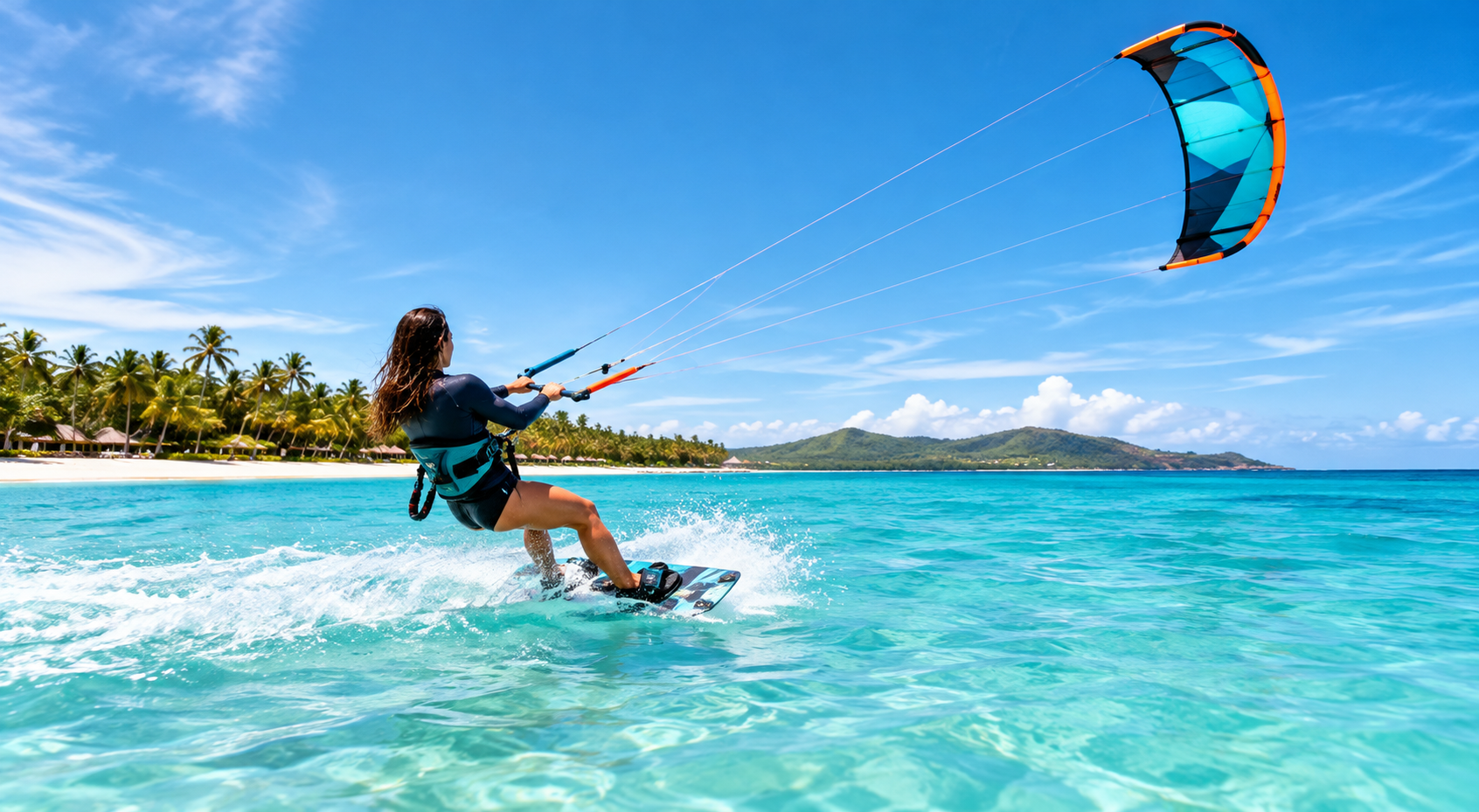
If you’ve been watching kites pull riders across the water and wondering whether you could do it yourself, the answer is probably yes. The harder question is where to start. If you’re comparing Kiteboarding courses Philippines options, you’ll find plenty of choices around the country’s better-known islands. Cuyo Island, part of Palawan province in the Sulu Sea, is a quieter alternative, and it’s where we run our lessons at Anino Kite Resort.
Why Cuyo Is a Good Place to Learn
Learning to kiteboard has as much to do with the place as it does with the lessons. Gusty conditions, choppy water, deeper water, and crowded beaches can make those first sessions more difficult.
Our beach on Cuyo’s east coast offers a different setting. During the Amihan season, generally from November through March, Cuyo receives its seasonal northeast winds. In front of the resort, there is a wide, clear lagoon with shallow areas suitable for practice and more than 400 meters of beachfront.
The lagoon gives beginners room to work on the basics while more experienced riders can explore different areas when conditions are suitable. As with any wind sport, conditions change, so lessons and riding are always planned around what the water and wind are doing on the day.
What Our Kiteboarding Courses Cover
A good beginner course follows a progression. Skipping ahead before you’re comfortable controlling the kite usually makes learning harder than it needs to be.
Our lessons start on the sand with basic theory, equipment setup, and safety systems. You then learn to launch and relaunch the kite and control it in shallow water.
From there, you move on to body dragging, where the kite pulls you through the water without a board, allowing you to understand how the kite responds. Water relaunches come next, followed by board riding: getting up, riding in both directions, maintaining your position against the wind, and making basic changes of direction.
The order matters. Kite control comes before board skills. Once you understand how the equipment behaves and what to do when the kite moves unexpectedly, learning to ride becomes much more manageable.
Lessons are taught by qualified Filipino and foreign instructors, and we can adjust the pace according to your experience and progress. Everyone learns differently, so there is no reason to rush through the process.
Learn Kiteboarding in the Philippines Without the Daily Commute
Logistics are an underrated part of learning. If your accommodation is a long drive from the beach, lesson days can become tiring before you’ve even started.
At Anino, the beach is right in front of you. We have three cottages and four double rooms, keeping the resort small and close to the water. You can walk from your room to your lesson and return for a shower or a rest when you’ve had enough for the day.
That also gives you more flexibility. Kiteboarding depends on wind conditions, so having the beach right outside means you don’t have to build every session around a transfer. When the conditions are suitable, you can get on the water. When they aren’t, the rest of the day is yours.
We also rent kiteboarding equipment, including kites, boards, and harnesses, so you don’t necessarily need to travel with a full set of equipment while you’re deciding whether the sport is for you.
Choosing the Right Course
Not every beginner arrives with the same background. Some have never touched a kite. Others have tried surfing, wakeboarding, windsurfing, or snowboarding, and some of that experience can be useful.
You don’t need to be an athlete either. Being comfortable in the water helps, while general fitness can make the first few days less tiring. But kiteboarding relies heavily on technique, timing, and kite control rather than simply physical strength.
When comparing courses, look beyond the number of lessons included. Ask about the teaching approach, the water where you’ll be learning, the equipment provided, and whether the instructors can adapt to your progress.
Safety should be part of that decision too. A proper introduction to equipment setup, launching, relaunching, and kite control gives you knowledge that remains useful long after your first course.
When to Come
The main kiteboarding season in Cuyo generally follows the Amihan period, roughly from November through March. This is when the island’s seasonal wind conditions are most suitable for the sport, although conditions can vary from one day to another.
Nobody can guarantee wind on a particular day, so it is sensible to allow several days for your trip if learning to kiteboard is the main purpose of your visit. The number of sessions needed will also vary from person to person.
And when the wind isn’t suitable for riding, there is still plenty to do. You can spend time on the beach, explore the island, visit the nearby marine sanctuary, or simply enjoy the slower pace of Cuyo. Boat trips to other islands may also be arranged depending on weather and sea conditions.
Getting Here
Cuyo takes a little more planning to reach than some of the Philippines’ major tourist islands. That extra effort is also one reason the destination retains a quieter atmosphere.
Cuyo can be reached by sea from Puerto Princesa in Palawan and Iloilo on Panay, with available services and schedules subject to change. Depending on the season and operator, private or charter flight options may also be possible.
If you’re planning to bring kiteboarding equipment or have connecting flights to arrange, it is worth contacting us before booking the final parts of your journey. We can help you understand the available options and plan your arrival around your stay.
Ready to Learn?
If you want to learn kiteboarding in Philippines on a quieter beach, with room to practice and your accommodation only steps from the water, Cuyo is worth considering.
At Anino Kite Resort, you can combine structured kiteboarding lessons with a beachfront stay and time to experience Cuyo beyond the kite. For anyone comparing Kiteboarding courses Philippines options, the setting matters just as much as the course itself.
To ask about courses, dates, equipment, or availability, get in touch through the Anino Kite Resort website, and we’ll be happy to help you plan your stay.